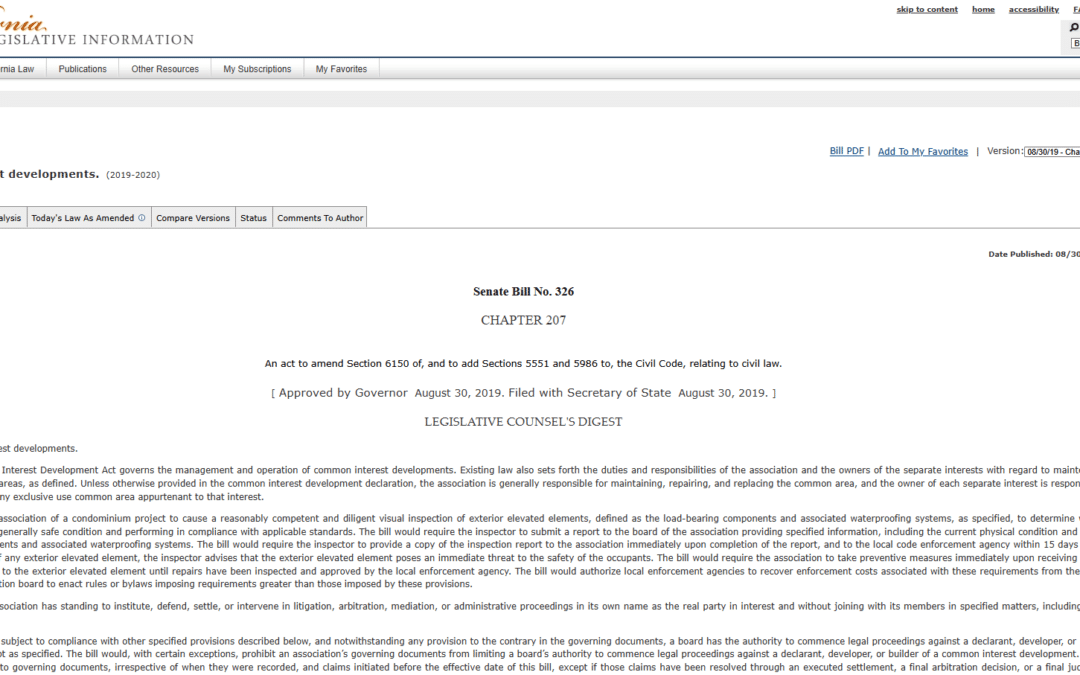
California continues to tighten safety regulations for condominium buildings, especially those with balconies, decks, and other exterior elevated elements. Senate Bill 410 – SB 410 represents the next phase of that effort. While many people mistakenly view SB 410 as a brand-new inspection law, the bill actually strengthens, clarifies, and enforces requirements that already exist under California Civil Code §5551, which SB 326 originally created.
As SB 410 takes effect in January 2026, condominium associations, property managers, inspectors, and owners must understand how the law changes compliance expectations and why delay now carries greater risk than ever before.
This article explains what SB 410 is, what inspections it requires, how enforcement increases, and how the law affects safety, insurance, and real estate transactions across California. See our article in Associated Press wire.
The Background: Why California Strengthened Balcony Laws
California enacted SB 326 in 2019 after the deadly 2015 Berkeley balcony collapse killed six people and injured many others. Investigators traced the failure to concealed dry rot caused by long-term moisture intrusion—damage that visual inspections never revealed.
SB 326 responded by requiring condominium associations to inspect exterior elevated elements (EEEs) such as balconies and decks. However, over time, regulators identified weaknesses in compliance. Many associations delayed inspections, misunderstood timelines, ignored reports, or failed to document repairs properly.
SB 410 closes those gaps.
Rather than creating a new inspection program, SB 410 tightens enforcement, clarifies definitions, standardizes documentation, and increases accountability for boards and managing agents.
What SB 410 Does—In Plain Terms
SB 410 amends Civil Code §5551 and focuses on five core areas:
Clarifying inspection and reporting standards
Strengthening repair timelines
Standardizing documentation and records
Increasing board and manager accountability
Aligning compliance with insurance and real estate transactions
The law makes clear that condominium associations must inspect, document, act, and retain records, not simply schedule an inspection and move on.
What Structures Does SB 410 Cover?
SB 410 applies to condominium projects with three or more attached units and focuses on exterior elevated elements, including:
-
Balconies
-
Decks
-
Stairways
-
Landings
-
Walkways
-
Bridges
-
Other load-bearing exterior components
The law covers these elements when they rely in whole or in substantial part on wood or wood-based products for structural support.
Who Must Perform SB 410 Inspections?
SB 410 requires condominium associations to hire licensed professionals, including:
-
Licensed architects
-
Licensed civil engineers
-
Licensed structural engineers
These professionals must evaluate the safety and structural integrity of exterior elevated elements. The law does not allow unlicensed visual-only inspections to satisfy §5551 requirements.
SB 410 Inspection Timelines: What Changes in 2026?
SB 410 does not reset inspection deadlines. Associations already had to complete their first inspection cycle by January 1, 2025 under SB 326.
What SB 410 changes is what happens next.
Under SB 410:
-
Associations must conduct inspections at least every six years
-
Boards must review reports, not ignore them
-
Associations must prioritize repairs based on safety risk
-
Boards must act within defined timelines
-
Associations must retain inspection and repair records
SB 410 makes clear that inaction now counts as a compliance failure.
Repair Obligations Under SB 410
SB 410 draws a firm line between identifying problems and fixing them.
When inspections reveal conditions that pose an immediate safety threat, associations must act promptly. Boards can no longer defer repairs indefinitely or delay action due to budget discomfort or internal disagreement.
SB 410 increases exposure for associations that:
-
Ignore inspection findings
-
Delay known repairs
-
Fail to document corrective actions
-
Allow unsafe conditions to remain accessible
Deferred maintenance now carries measurable legal and financial consequences.
How SB 410 Affects Insurance
Insurance companies already scrutinize condominium risks aggressively in California. SB 410 reinforces that trend.
Insurers increasingly require proof of:
-
Completed §5551 inspections
-
Professional inspection reports
-
Documented repairs
-
Ongoing maintenance plans
Associations that cannot produce records may face:
-
Policy non-renewals
-
Premium increases
-
Reduced coverage
-
Exclusions related to balconies or decks
SB 410 effectively turns inspection documentation into an insurance underwriting tool.
How SB 410 Affects Real Estate Transactions
SB 410 also changes the real estate landscape.
Buyers, lenders, and escrow officers increasingly request:
-
Proof of compliance with Civil Code §5551
-
Inspection reports
-
Repair disclosures
-
Reserve planning related to balconies and decks
Associations that fail to comply risk:
-
Delayed escrows
-
Cancelled sales
-
Financing denials
-
Disclosure disputes
While SB 410 does not explicitly ban sales, it raises the standard of due diligence, making noncompliance a transaction obstacle rather than a background issue.
Financial Planning Under SB 410
SB 410 forces associations to think long-term.
Boards must budget for:
-
Professional inspections every six years
-
Anticipated repairs
-
Preventive maintenance
-
Reserve allocations
While compliance costs money, emergency repairs, lawsuits, and insurance losses cost far more. Associations that plan proactively reduce long-term exposure and stabilize property values.
The Role of Inspectors and Engineers
Inspection professionals now play a central role in compliance.
Licensed inspectors must deliver:
-
Clear, defensible reports
-
Accurate risk prioritization
-
Documentation that supports board decisions
-
Records that stand up to insurance and legal review
SB 410 raises expectations for inspection quality and clarity. Vague reports no longer serve associations well.
Impact on Residents and Communities
Residents benefit directly from SB 410.
The law:
-
Reduces the risk of structural failure
-
Improves transparency
-
Encourages proactive maintenance
-
Builds trust between boards and owners
Associations that comply demonstrate responsibility, competence, and commitment to safety.
What SB 410 Means Going Into 2026
SB 410 marks a turning point.
California no longer tolerates delayed balcony inspections, ignored reports, or undocumented repairs. The law requires inspection, action, and accountability.
For condominium associations, SB 410 demands leadership. For inspectors, it raises professional standards. For owners, it improves safety and protects property value.
Most importantly, SB 410 aims to prevent the kind of tragedy that prompted these laws in the first place.
Final Takeaway
SB 410 does not introduce a new inspection concept—it enforces one.
As 2026 approaches, condominium associations that understand and act now will avoid legal exposure, insurance disruption, and transaction delays. Those that wait will face higher costs, greater scrutiny, and fewer options.
SB 410 sends a clear message: inspect, document, repair, and protect lives before failure forces the issue.
Your content goes here. Edit or remove this text inline or in the module Content settings. You can also style every aspect of this content in the module Design settings and even apply custom CSS to this text in the module Advanced settings. Your content goes here. Edit or remove this text inline or in the module Content settings. You can also style every aspect of this content in the module Design settings and even apply custom CSS to this text in the module Advanced settings. CSS to this text in the module Advanced settings.